▌ CASE STUDY · SMART CONSTRUCTION SITE · BONTANG, INDONESIA
Indonesia's first soda ash project — a smart site platform live in 15 days
PT Pupuk Kalimantan Timur is building the country's first soda ash plant at Bontang, East Kalimantan, with China Tianchen Engineering Corporation as EPC contractor. Shandong Zhinuo supplied the smart construction site platform — six systems covering people, plant, environment and management — and brought every one of them online in fifteen days.
This is what the site looked like before the platform, what was deployed, and how fifteen days was actually done.
PROJECT AT A GLANCE
▌ OWNER PT Pupuk Kalimantan Timur (PKT), part of Indonesia's state-owned Pupuk Indonesia group
▌ LOCATION Kaltim Industrial Estate (KIE), Bontang, East Kalimantan, Indonesia
▌ PROJECT Indonesia's first 300,000 t/y soda ash plant
▌ EPC CONTRACTOR China Tianchen Engineering Corporation (TCC), part of CNCEC
▌ SMART SITE BY Shandong Zhinuo Safety Technology Co., Ltd.
▌ DURATION 15 days from equipment entering site to full system operation
▌ COVERAGE Construction area, office area and living quarters
▌ 01 THE PROJECT
Indonesia's first soda ash plant
PT Pupuk Kalimantan Timur (PKT) is a core subsidiary of Indonesia's state-owned Pupuk Indonesia group and one of Southeast Asia's largest integrated ammonia and urea producers — more than 3.4 million tonnes of urea and 2.7 million tonnes of ammonia a year.
To close Indonesia's domestic soda ash gap and cut its reliance on imported soda ash, PKT launched the country's first 300,000 t/y soda ash project, using Hou's process — the combined soda ash and ammonium chloride route developed in China. The plant will also produce 300,000 t/y of ammonium chloride, with commercial operation planned for March 2028. It is designated a national strategic project.
The plant is being built by China Tianchen Engineering Corporation (TCC), a core engineering company of CNCEC, under an EPC contract. It is the first time Hou's process has been built in Indonesia.
▌ 02 FIVE CHALLENGES
What a megaproject looks like on the ground
The plant sits inside KIE, an important chemical cluster in eastern Indonesia where several fertiliser and chemical units are already running. The new soda ash plant is being built next to operating plant, so safety and environmental control are held to a very high bar. Five challenges shaped the brief for the smart site.
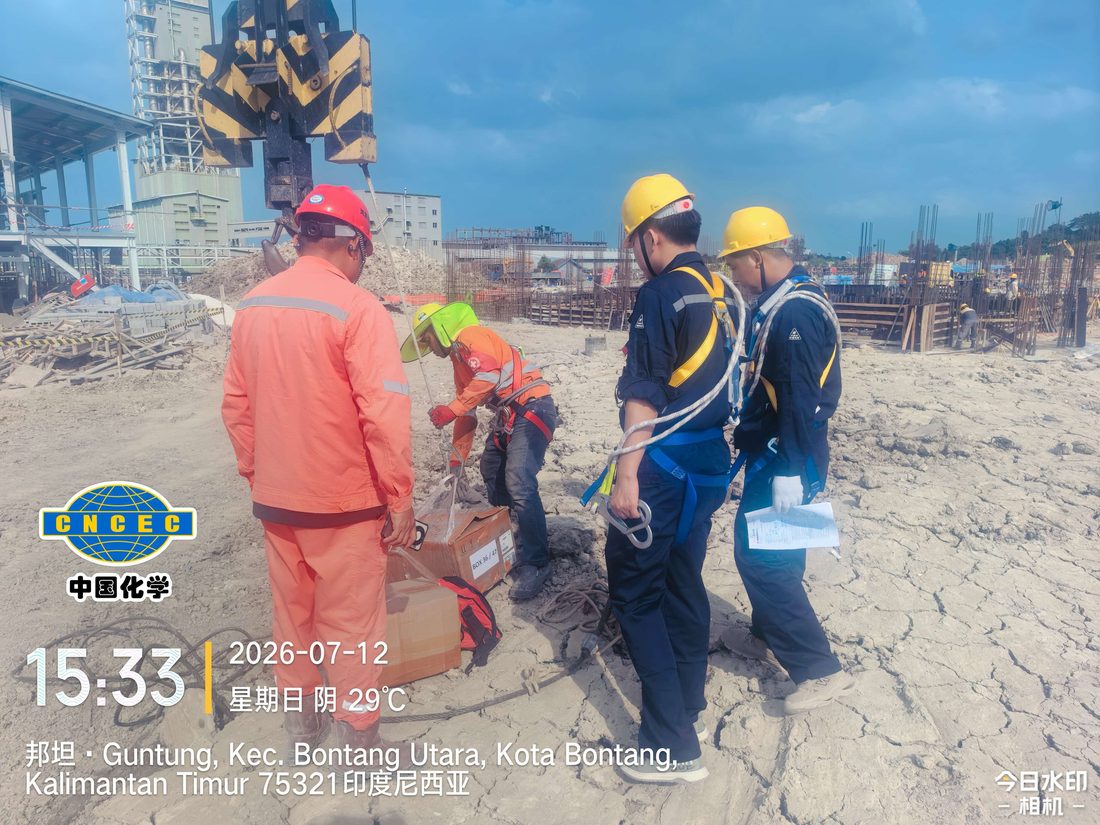
FIG 1 · Crews working on the soda ash project site at Bontang — the environment the smart site platform had to cover.
▌ PEOPLE Chinese managers and technicians, Indonesian labour and third-country suppliers all work side by side. With language and cultural differences, paper registration is slow and error-prone, and gate control and attendance are hard to keep accurate.
▌ LIFTING SAFETY Three tower cranes handle vessel lifting and assembly of large machinery. Dense process units, frequent lifts, wide blind zones and crossing work areas — traditionally managed on the driver's experience and a signaller's instruction, with no live data and no warning.
▌ ENVIRONMENT PKT sets strict internal limits on construction dust and noise, and Indonesian regulators keep tightening supervision of industrial estate projects. Manual water spraying cannot hold a 24-hour standard.
▌ CONNECTIVITY Network coverage inside Indonesian industrial estates is uneven and unstable. Site video and data faced bandwidth and signal problems from day one, so the architecture had to be designed for it.
▌ THE CLOCK An EPC schedule with no slack. The smart site had to be designed, shipped, installed and running almost immediately, to support safety management for the main construction works.
▌ 03 WHAT WAS DEPLOYED
Six systems, one platform
Zhinuo configured a single package covering people, plant, environment and management, deployed at the same time across the construction area, the office area and the living quarters.
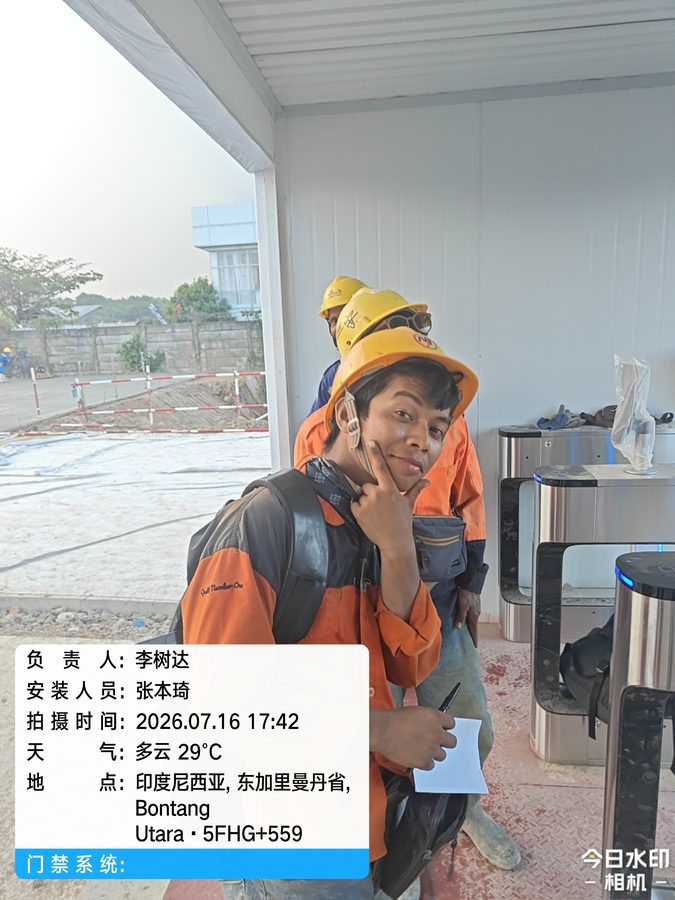
FIG 2 · Face recognition at the gate: registration, recognition and attendance in one pass, uploaded to the platform in real time.
▌ LABOUR REGISTRATION Face-recognition turnstiles and a real-name registration system at both main gates, handling registration, face recognition and attendance as one flow. The face database works across ethnicities, and every entry and exit goes straight to the platform — so managers can see how many people are on site, who they are, and what the attendance record says.
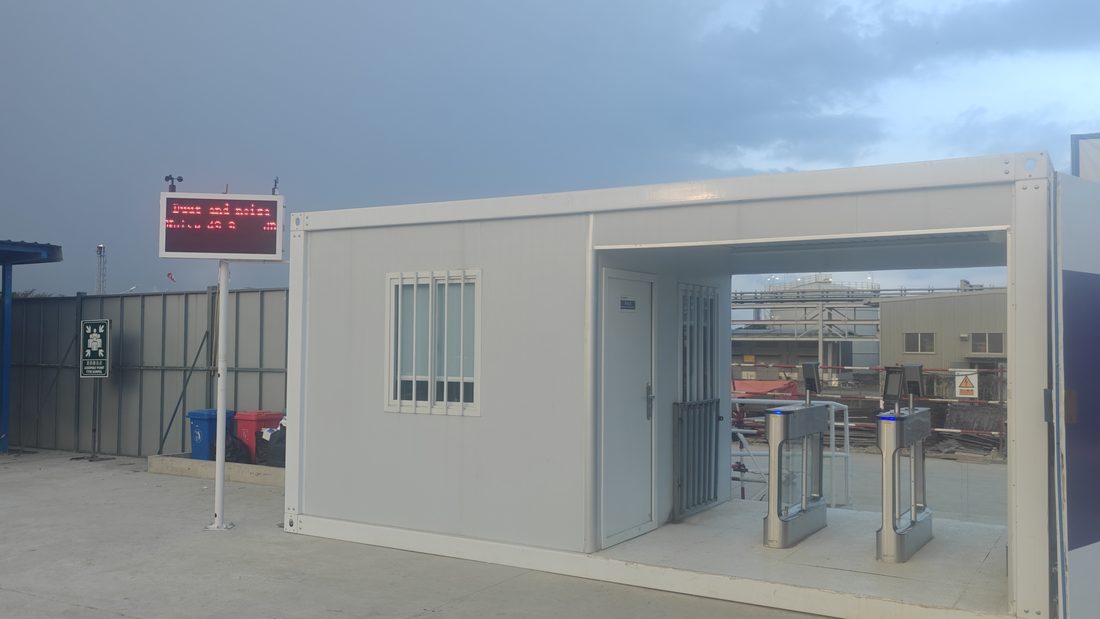
FIG 3 · The main gate at KIE: turnstiles and the registration point, with the site information display board alongside.
▌ SITE-WIDE VIDEO PTZ and bullet cameras across all three zones — work faces, material storage, crane operating areas, gate entrances, public areas of the accommodation. Streams run to an on-site monitoring centre and to the cloud, with live view, playback and remote retrieval, so the site office and head office see the same picture.
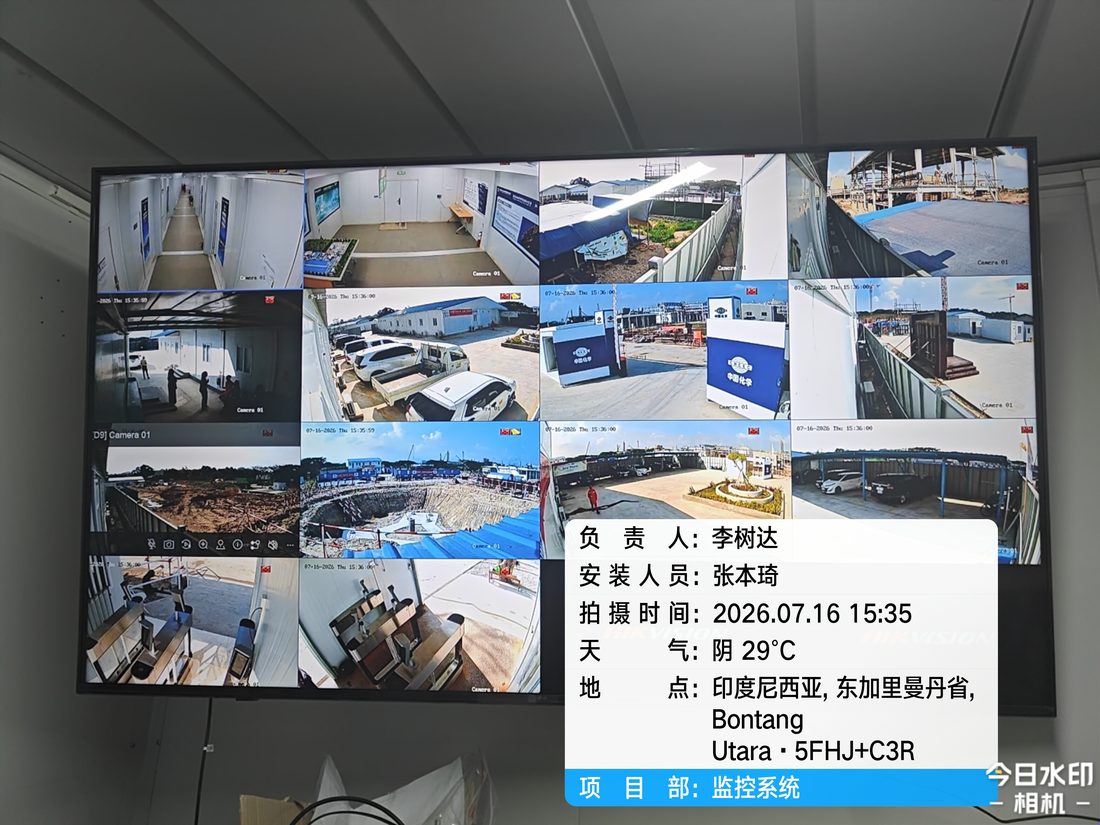
FIG 4 · The monitoring centre video wall: live feeds from across the site, with recognition records arriving alongside them.
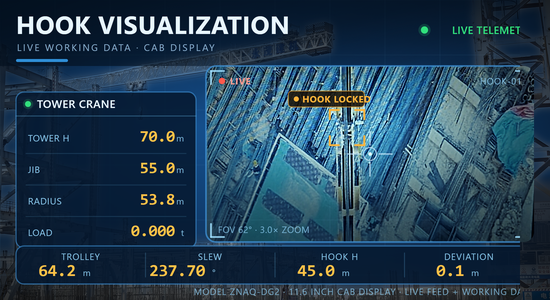
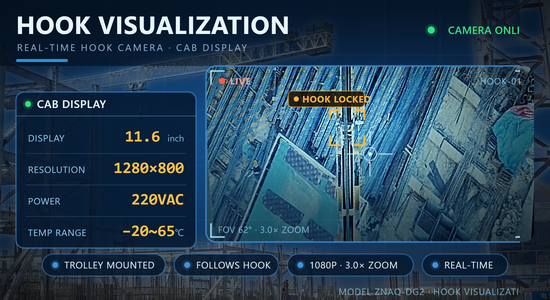
▌ TOWER CRANE MONITORING Monitoring terminals on all three tower cranes read load, radius, height, slewing angle and wind speed in real time. Limit protection raises an audible and visual alarm and restricts the dangerous motion; every reading is logged to the platform for traceability and behaviour analysis.
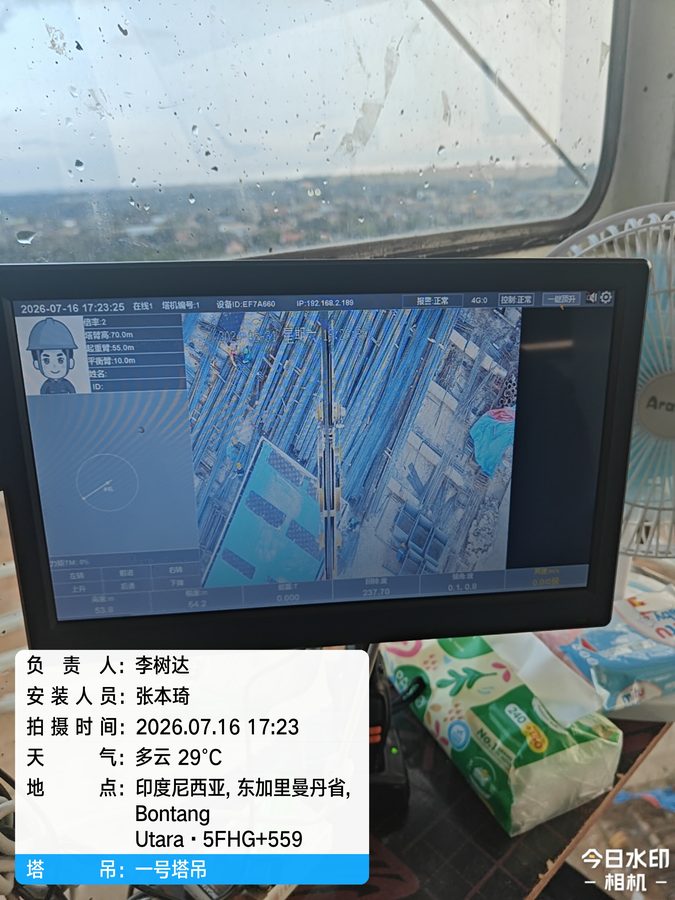
FIG 5 · In the cab: live picture and monitoring data on one terminal, so the operator is never working blind.
▌ DUST & NOISE Combined monitors at the gate and at key points track PM2.5, PM10, TSP, noise, temperature, humidity and wind speed and direction. Values above threshold automatically start the spray system — unmanned dust control around the clock, with the data trail regulators ask for.
▌ SITE NETWORK A hybrid fibre-plus-wireless design: a fibre backbone between the construction, office and living areas, Wi-Fi access points inside each, and local storage with edge nodes so critical data is cached when the link drops and synced when it returns.
▌ ONE PLATFORM Every sub-system feeds one command platform, on desktop and mobile, with a bilingual Chinese and English interface for both sides of the team: data dashboards, hazard alerts, automated reports and cloud archiving.
▌ 04 FIFTEEN DAYS
Three phases, one deadline
Deployment was a race against the clock. Zhinuo sent an implementation team to Indonesia and went from equipment clearing customs to a fully live system in fifteen days.
▌ DAYS 1–5 Survey and foundations. A full walk-down of all three zones to fix every camera point, gate position, dust monitoring point, crane mounting position and cable route — then fibre laying, switches, Wi-Fi access points and network commissioning, the communications base for everything that followed.
▌ DAYS 6–10 Hardware and standalone testing, four crews in parallel: turnstiles at both gates; cameras installed, wired and aimed across the site; monitoring terminals fitted and calibrated on all three cranes; dust and noise monitors commissioned and their data links tested. Each device was functionally tested the moment it was fitted.
▌ DAYS 11–15 Integration and commissioning. All sub-systems onto the platform, with data mapping, interface configuration, permissions and alarm rules, then end-to-end testing of gate recognition, video preview, crane data upload, dust alarms and mobile push. Project staff on both the Chinese and Indonesian side were trained. On day 15 the system went live.
Through it all the team worked around language barriers, humid tropical weather, customs delays and patchy site connectivity — and still handed over on schedule, which is what won the recognition of TCC and of PKT.
▌ 05 WHAT IT CHANGED
Five measurable results
● People management. Every worker on site is registered digitally and attendance is counted automatically — and the mixed-crew, multi-language problem that defines overseas projects largely disappears. Management efficiency up by more than 60%.
● Safety. Site-wide video plus crane monitoring build a layered safety net: hazards are found and handled far faster, all three cranes have a complete operating record, and no lifting-equipment accident has occurred since the system went live.
● Environment. Dust and noise monitoring with automatic spraying runs unmanned around the clock. Readings stayed inside the limits, meeting PKT's internal standards and passing repeated inspections by Indonesia's environmental regulator.
● Decisions from data. Managers moved from judgement based on experience to decisions based on live figures, with a visible step up in how finely safety is managed.
● Overseas delivery. Fifteen days proved the team can deploy fast and support locally far from home — the capability behind the next projects in Southeast Asia.
▌ 06 WHY IT MATTERS
A template for taking a smart site overseas
Six systems working as one platform, on Indonesia's first soda ash project: labour registration, site-wide video, tower crane monitoring, dust and noise monitoring, a purpose-built site network, and a command platform in two languages. Together they gave the project a digital safety management chain running across the whole of construction.
The fifteen days came from three things: understanding what an overseas site is actually like, products that are ready to deploy rather than prototypes, and an implementation process refined until it has no wasted steps. The result supported TCC's construction safety management, showed the owner what Chinese smart-site technology can do, and stands as a reference for China–Indonesia cooperation in intelligent construction.
Zhinuo continues to develop its IoT and AI vision technology, with faster delivery and broader local support behind every project that goes overseas.
▌ ABOUT ZNAQ
Shandong Zhinuo Safety Technology develops and deploys integrated smart construction site platforms — labour registration and face recognition, site-wide video, tower crane safety monitoring, dust and noise monitoring, site networks and cloud command platforms — configured for each project and supported on site. Tell us the site, the machinery and the deadline, and we will scope the package and quote it.
▌ CONTACT shandongzhinuo@outlook.com +86 176 6371 0314 · en.znaqkj.com