
Smart devices / 单机可视化
Tower Crane Hook Visualization System
Hook Visualization System — HD along-boom (trolley/boom-tip) camera with auto-zoom streams via low-latency wireless TX/RX to cab display (10.1in 1080P IPS or 7–10in). For tower blind & night lifts.
Request a technical proposalKey specifications
- capacity
- Hook view for tower & truck cranes, auto-zoom
- material
- IP67 hydrophobic lens, magnetic mount, -30 to +70C
- communication
- Industrial TX/RX <150ms, 485 overlay, ONVIF video
- compliance
- ONVIF/RTSP, plugs to ZNAO-TG2 host for records
- safety_factor
- Blind lift accident reduction, 2-3min compressor awareness when paired
Application overview
Specified around the application
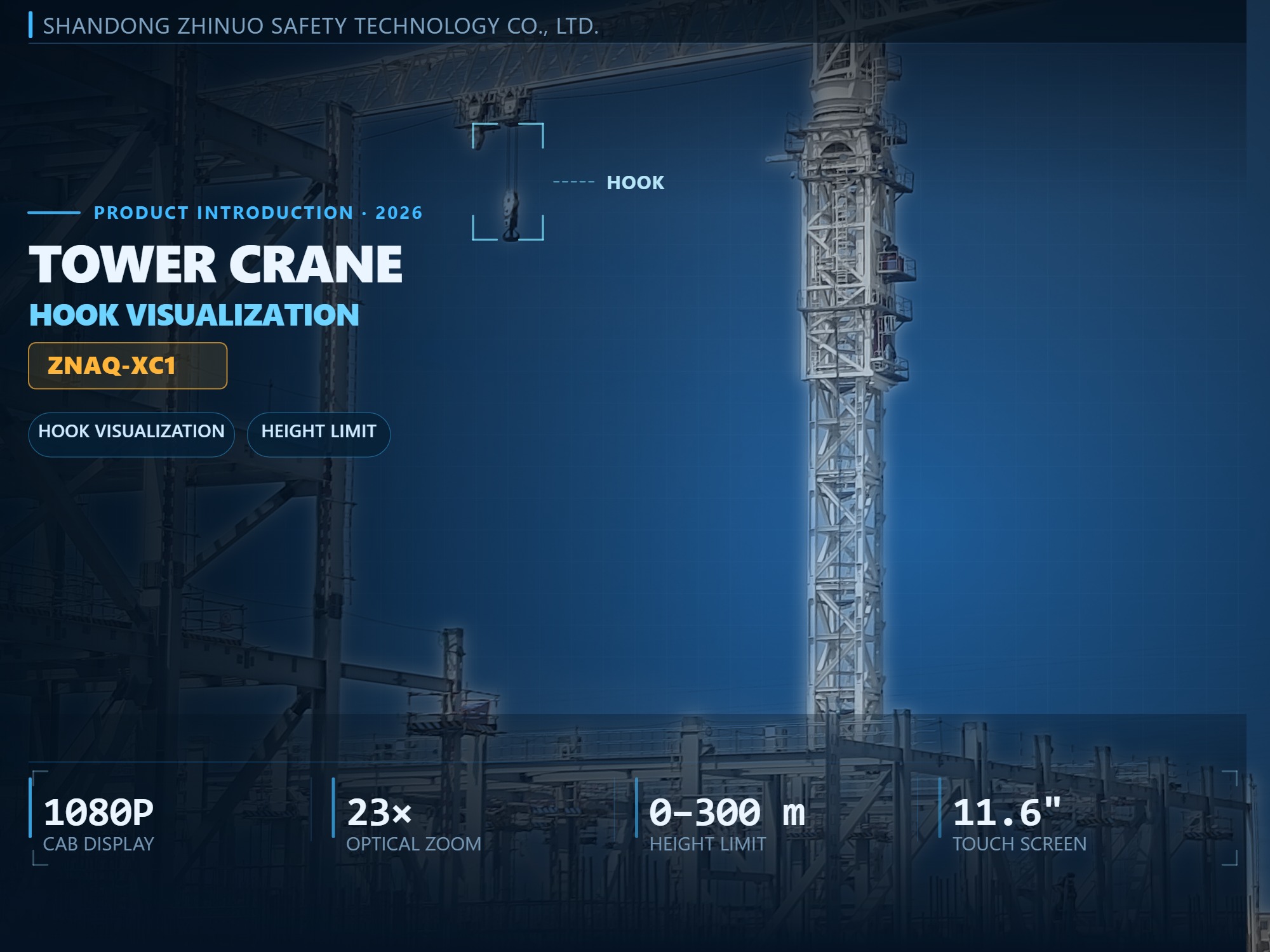 01PRODUCT OVERVIEW · ZNAQ-XC1
Tower crane hook visualization system (height limit only)
A camera is mounted on the trolley of the tower crane, looking straight down at the hook. Wherever the trolley goes, the picture follows, and it is delivered live to the 10.1-inch touch screen in the cabin. The driver no longer waits for a radio call from the ground or guesses how far the hook still is from the landing point — the landing point is on the screen.
XC1 is the simplest unit in the range: it does hook visualization and one height limit, nothing else. Hook height is read by an absolute encoder on the hoist drum, 0–300 m at 0.1 m resolution, and the limit is set once per crane on the host. Every unit ships as a standard kit, so the camera, the limit, the power and the charging all arrive as one package with nothing else to source.
1080P hook picture with 23× optical zoom
Trolley-mounted camera follows the hook — no blind zone
Height limit 0–300 m, 0.1 m resolution, set on the cabin screen
No welding and no structural change — bracket bites the existing steel
Interface language, body logo and hardware configuration made to order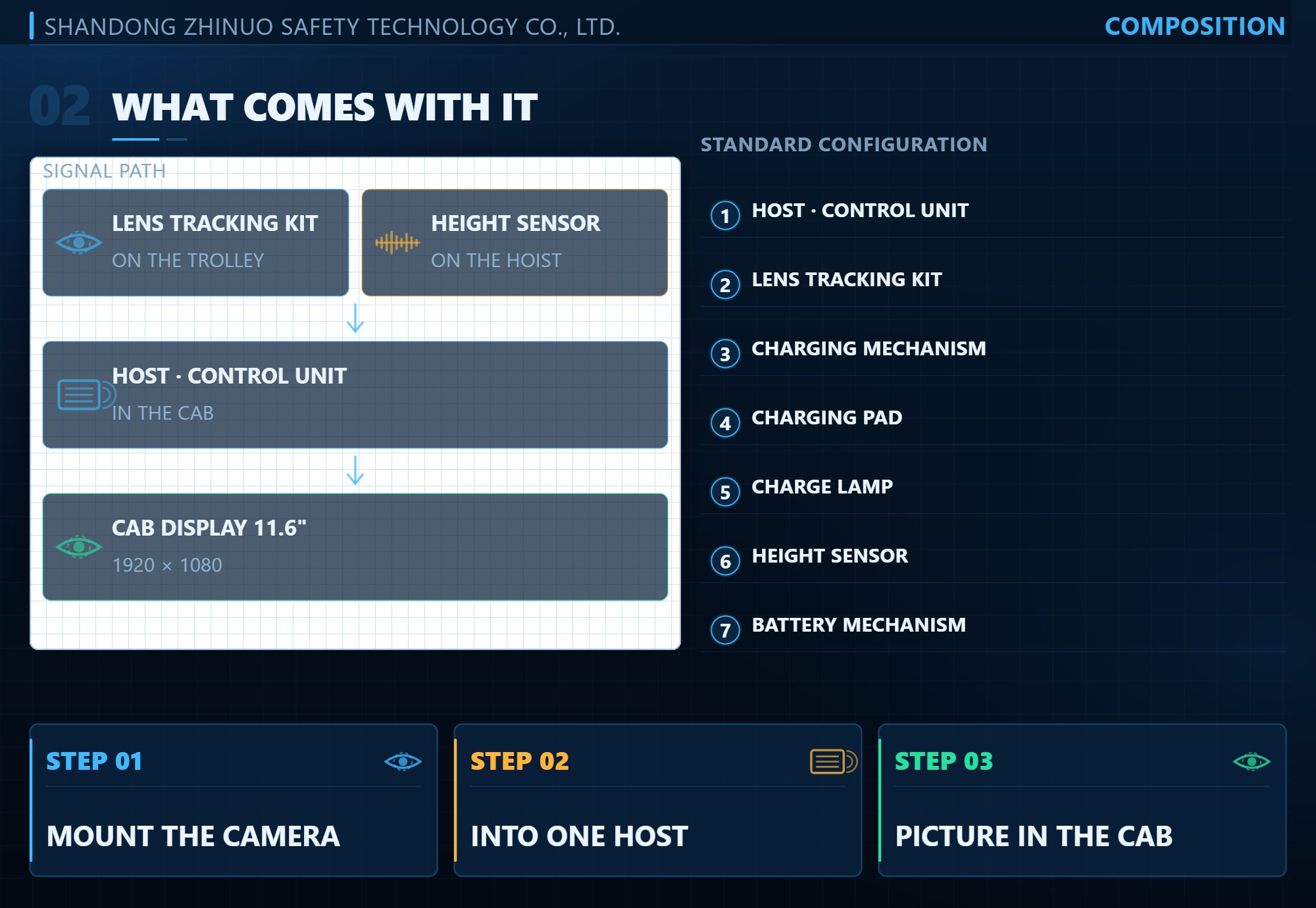 02SYSTEM COMPOSITION · STANDARD KIT
One path, from the hook to the cabin screen
There are only three steps in the chain. First, the lens tracking kit goes on the trolley — Camera unit that moves with the cart, featuring a 2-megapixel camera, 23x optical zoom, and an IP65 protection rating.the height sensor goes on the hoist and turns hook height into an absolute position signal. Second, both signals are collected and processed by one host inside the cabin: the hook picture and the height limit logic live in that single box, with no second control cabinet. Third, the host sends the picture and the height to the 11.6-inch cabin display, so the driver reads the view and the limit on the same screen.
The standard kit is named after our product introduction sheet: host (control unit), lens tracking kit, charging mechanism, charging pad, charge lamp, height sensor and battery mechanism. On site the seven parts are fitted to steel the crane already has, and the wiring is a one-time job.
Signal path: lens tracking kit + height sensor → host → cabin display
One host does all the picture and limit computation — no extra cabinet
Contact charging: the slew brings the mechanism into position, no cabling by hand
304 thickened steel charging pad with a slope buffer, no pole distinction
High-brightness LED charge lamp: red flashing = charging, green = full
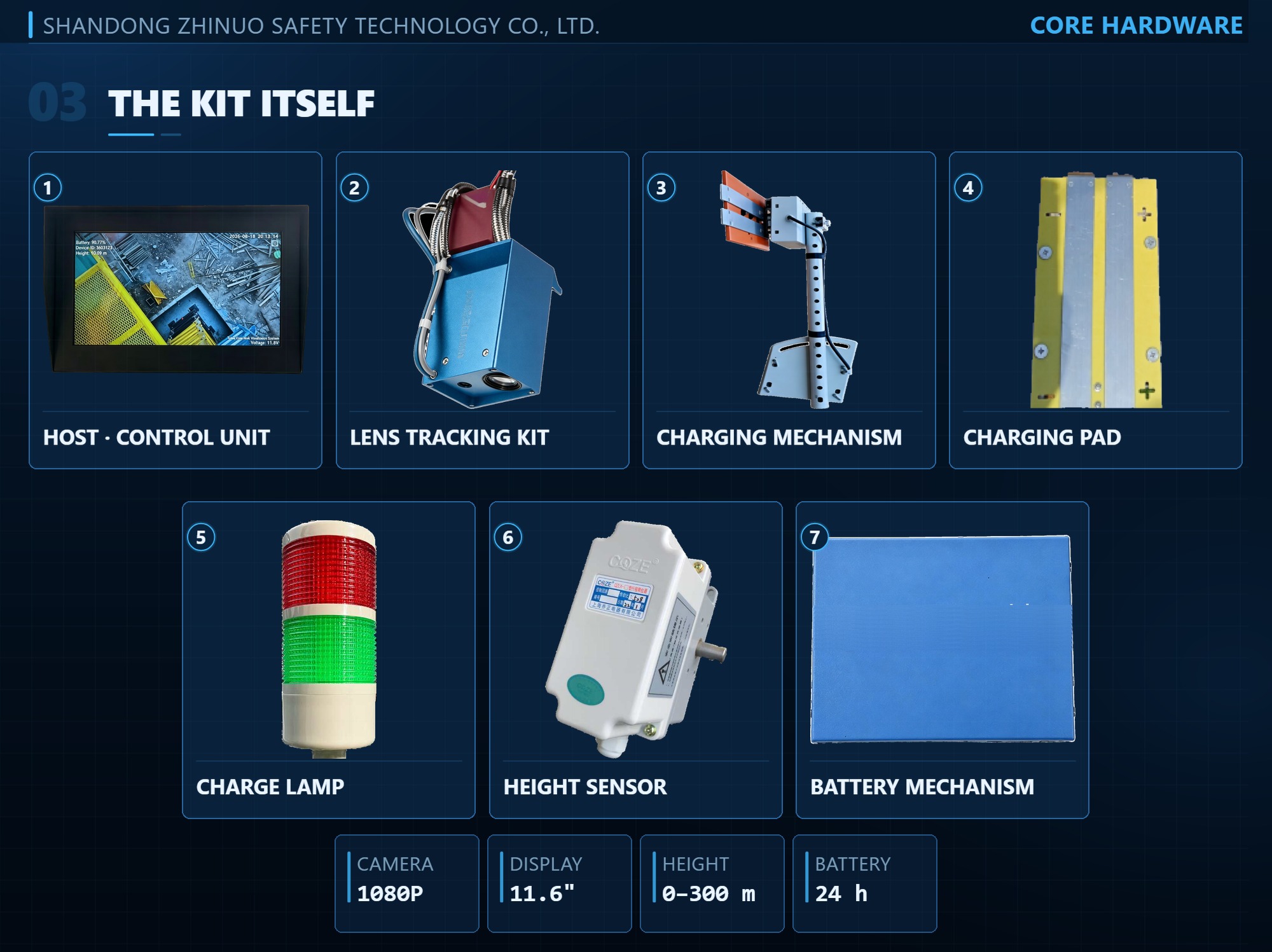 03CORE HARDWARE · STANDARD KIT
Every unit that goes on the crane
The main unit serves as the control terminal inside the operator's cabin; it features a 10.1-inch screen to display camera feeds and height data, and allows for the configuration of height limit values. The camera tracking assembly includes a 2-megapixel camera unit mounted on the trolley (supporting 23x optical zoom, IP65 protection, and 12V DC power); as it moves with the trolley, the hook remains within the field of view throughout the entire lowering process.
The height sensor utilizes an absolute encoder: 0–300m range, 0.1m resolution, IP65 protection, and a maintenance-free design. Power is supplied by a 10A battery pack offering 24 hours of runtime per charge, with automatic recharging via a contact-based mechanism; this mechanism supports 360° rotation, is constructed from 304 stainless steel, and attaches to the crane structure using a serrated clamping design compatible with various tower crane types. A charging dock combined with a high-brightness LED indicator forms the complete charging system, with indicator colors corresponding to different charging states.
Camera: 2-megapixel sensor, 23x optical zoom, IP65 protection, 12V DC power
Cabin Display: 11.6-inch 1920×1080 tempered glass touchscreen
Height Limit: Absolute encoder, 0–300m range, 0.1m resolution
Battery: 10A battery pack, 24-hour runtime per charge, contact-based charging
Charging Mechanism: 360° rotation, 304 stainless steel, serrated clamping structure
Solar Charging System: Optional; not included in the standard configuration
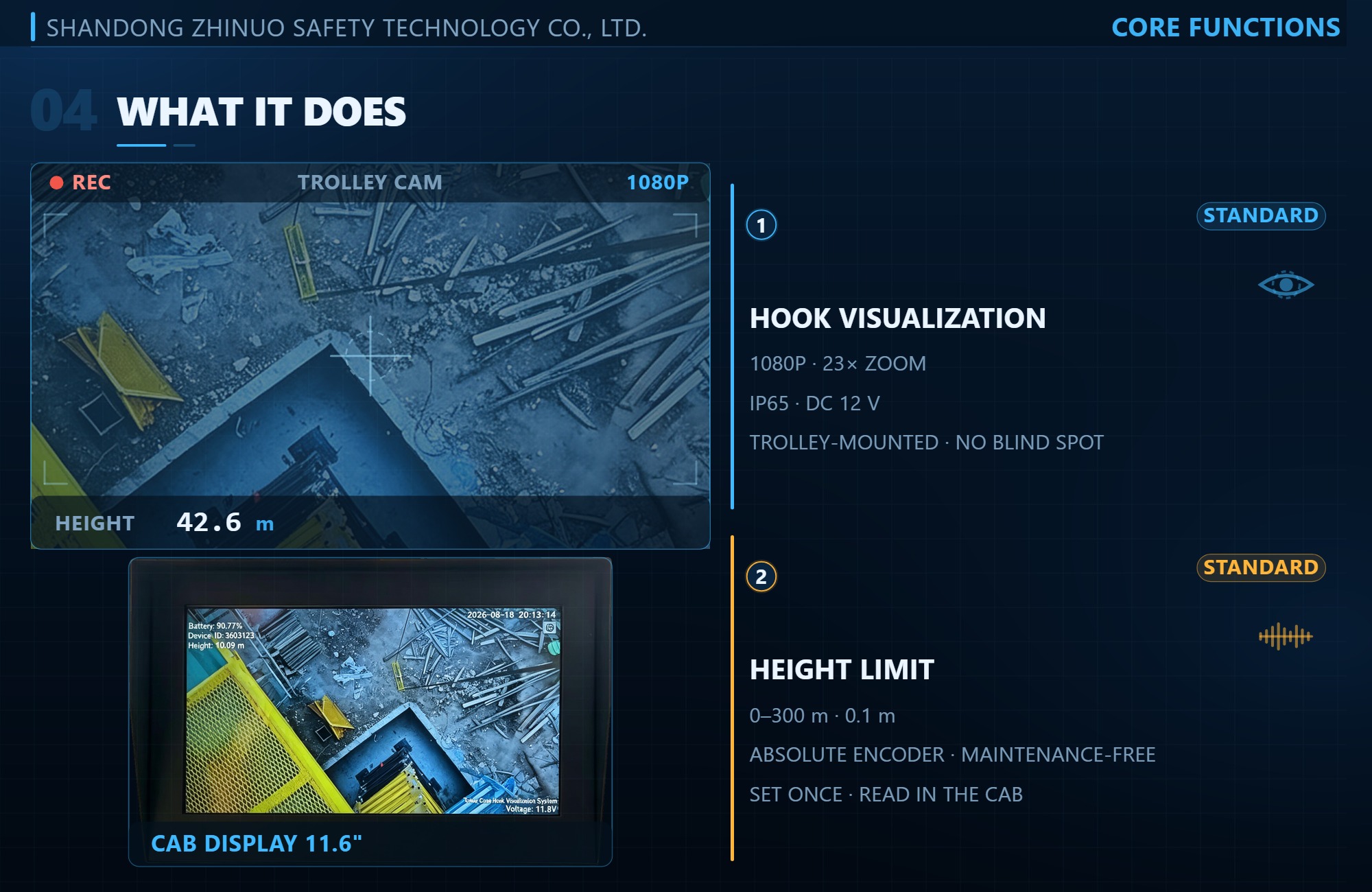 04CORE FUNCTIONS · TWO JOBS
See the hook, hold the height
The first job is hook visualization. The camera sits on the trolley and looks down at the hook, and the picture is sent live through the host to the cabin display. As the hook travels down, the picture travels with it: where the hook is, how far it still is from the landing point and whether anyone is underneath are all on the screen, so the driver no longer depends on hand signals or radio calls from the ground. The downward view matters most over the last few metres of the pick — which is exactly where incidents tend to happen.
The second job is the height limit. An absolute encoder on the hoist drum measures hook height continuously, 0–300 m at 0.1 m resolution. The limit is set per crane, and when it acts, it acts on the hoisting mechanism — the driver is not left to stop the movement himself. The whole setup is done on the cabin screen, with no separate hand-held controller and no help needed from the ground.
1080P hook picture, moving with the trolley over the whole travel
Crosshair and corner brackets help the driver line up the landing point
Live height shown under the picture, in metres
Limit set per crane on the cabin screen, action taken on the hoist
Picture and limit on one screen — no switching between devices
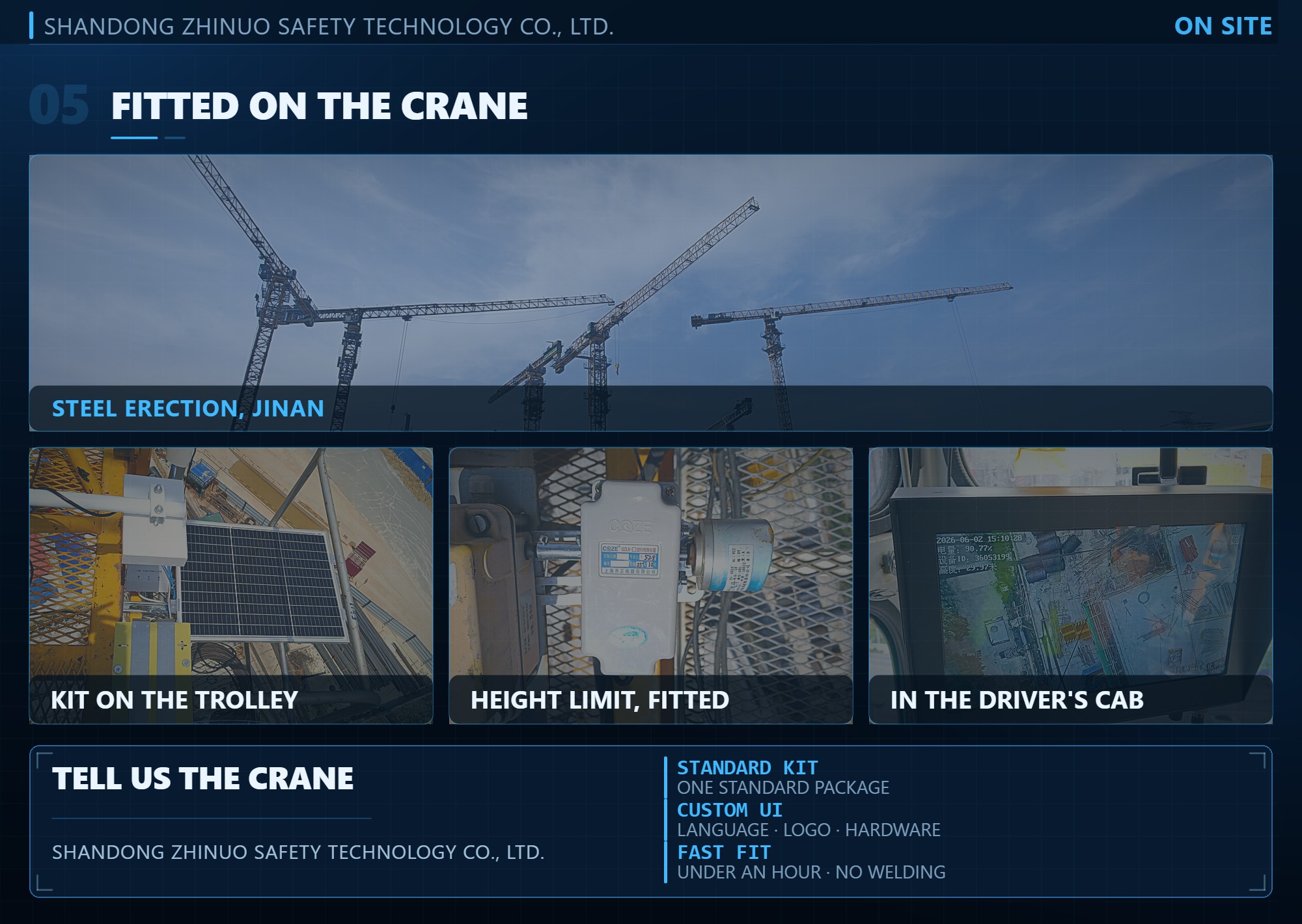 05ON SITE · FROM OUR OWN PROJECTS
Fitted on the crane: trolley, hoist, cabin
The first photograph is the trolley bracket: solar panel, contact charging pad and warning lamp on one fitting that travels with the trolley. The panel tops the battery up between shifts, and when the trolley returns to the jib root the pad bites the charging mechanism and charging starts by itself — nothing to plug in by hand. The two yellow rails are the charging pad itself, 304 stainless steel with a slope buffer; the red and green stack beside them is the charge lamp.
The second photograph is the height limiter on the hoist drum shaft. The absolute encoder is taken straight off the drum, wired once at installation and maintenance-free from then on, reading 0–300 m at 0.1 m. The third is the cabin: the 11.6-inch screen in front of the driver is where the hook picture lands, live from power-on, with nothing extra for the operator to do. The standard kit fits on site — clamp bracket, no welding, no structural change — and interface language and body logo can be made for your market.
Trolley kit: solar panel, contact charging pad and charge lamp on one bracket
Docks and charges by itself at the jib root — nothing to plug in
Height limiter on the hoist drum shaft, wired once, maintenance-free
11.6-inch cabin display, live from power-on, nothing to operate
Clamp bracket, no welding; interface language and body logo to order
Product gallery
Visual context for configuration review
Next step
Compare related products
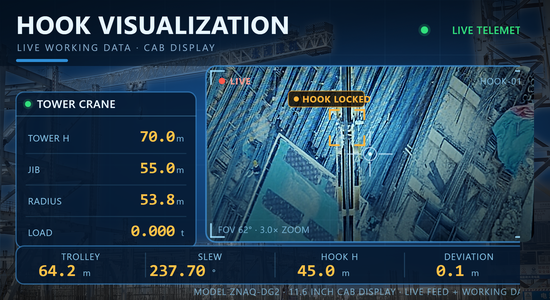
Tower crane 3-in-1 visual safety system
This "three-in-one" visual safety system for tower cranes utilizes a modular industrial platform design and features an 11.6-inch 1080P IPS display unit that monitors load, moment percentage, weight, anti-collision status, working radius, height, tilt angle, and wind speed in real time. It integrates a hook-tracking camera, a 360° panoramic imaging system, in-cab facial recognition, and millimeter-wave radar. The system employs wireless bridge transmission technology (ensuring zero latency), boasts an IP67 protection rating, and operates within a temperature range of -30°C to +70°C. It comes equipped with magnetic sensors (allowing for installation without cutting), a wired mouse, and a 12V in-cab power adapter. Comprehensive technical documentation is provided to meet the requirements for special equipment inspections and "smart construction site" acceptance standards.
Tower crane 3-in-1 visual safety system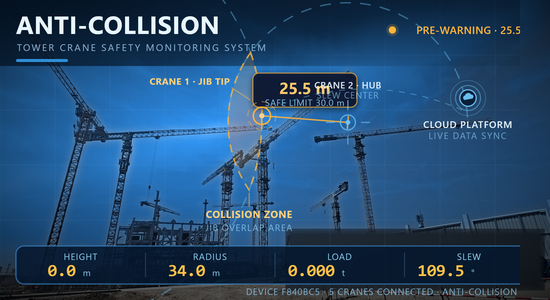
Tower Crane Safety Monitoring System — ZNAO-TG2 Black Box
The ZNAO-TG2 tower crane safety monitoring system (black box) features real-time six-axis sensing capabilities—covering height, trolley radius, slewing angle, load, wind speed, and tilt—along with intelligent alarms for limit violations. It supports automatic networking for anti-collision among tower crane groups and offers eight types of zoning restrictions (including linear, triangular, quadrilateral, and circular areas). Equipped with an industrial-grade display, the system supports 4G and 433MHz communication and includes RS485, LAN, and ONVIF interfaces, enabling connectivity with hook-mounted cameras and integration with management platforms.
Tower Crane Safety Monitoring System — ZNAO-TG2 Black BoxNeed documentation or a technical review?
Send the project inputs and we will confirm suitability, configuration, documentation, and delivery options.
Online inquiry
Request a quotation for this product
Describe the application and site conditions, and our engineering team will confirm configuration, documentation, and delivery.